

Helium Leak Testing for High-Reliability Liquid Cooling Assemblies
1. Introduction: The Unforgiving Reality of High-Density Thermal Management
In high-density data centers powering artificial intelligence, machine learning clusters, and cloud infrastructure, thermal design has reached a critical turning point. Standard forced-air cooling can no longer handle the extreme heat flux generated by modern high-density server racks. Direct-to-chip (D2C) liquid cooling loops, rear-door heat exchangers (RDHx), and cooling distribution units (CDUs) have shifted from optional upgrades to core operational infrastructure.
At the heart of these thermal systems are complex networks of 316L and 304L stainless steel manifolds, quick-disconnect fittings, flexible braided hoses, and precision-welded distribution pipework. These components transport dielectric fluids, deionized water, or glycol-water mixtures directly above high-value GPU and CPU arrays.
For procurement managers, thermal architects, and quality assurance engineers, the margins for error are non-existent. A single fluid droplet escaping a micro-crack in a welded manifold joint can trigger short circuits, hardware damage, and millions of dollars in unscheduled downtime.
To guarantee multi-year operational reliability, traditional pressure testing methods are no longer sufficient. Achieving zero-defect performance requires rigorous vacuum chamber helium leak testing integrated directly into a streamlined, high-precision manufacturing process.
2. Unpacking Buyer Pain Points: The Hidden Risk of Micro-Leaks
When sourcing custom liquid cooling assemblies, engineering and procurement teams face distinct operational challenges that directly impact product lifecycle and project profitability.
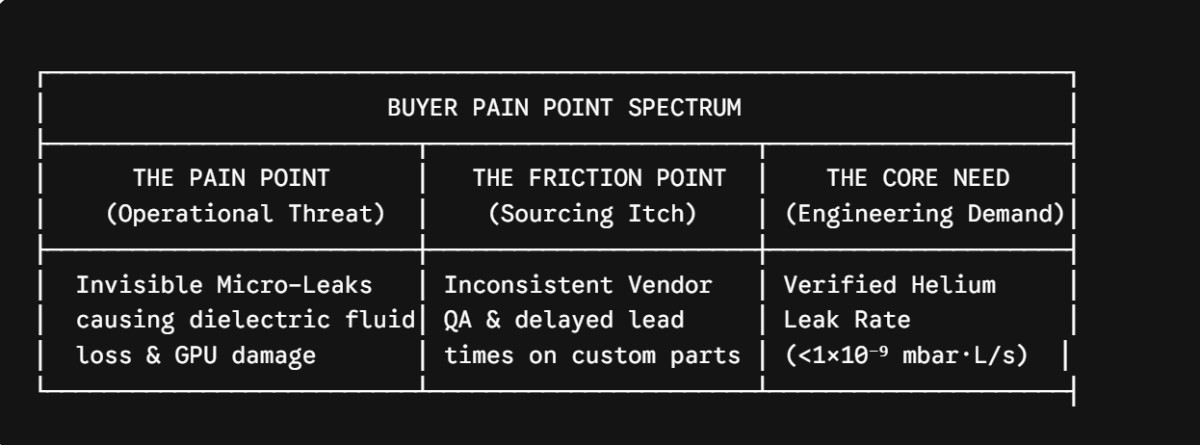
The Pain Point: The Catastrophic Cost of "Invisible" Micro-Leaks
Standard hydrostatic bubble tests or air-under-water submersion checks only detect leak rates down to 10⁻³ or 10⁻⁴ mbar·L/s. However, in pressurized liquid cooling loops operating continuously for 5 to 10 years, microscopic pores or intergranular weld fissures as small as 10⁻⁸ mbar·L/s will gradually weep fluid. Under high pressure and continuous thermal cycling, these micro-fissures expand, resulting in sudden pressure drops or localized fluid spray over active circuit boards.
The Friction Point (The Itch): Bottlenecks in Custom Manufacturing Workflows
System integrators often face a dilemma: choose standard off-the-shelf components that fail to meet strict space constraints, or partner with custom fabrication shops that lack advanced testing equipment. Traditional fabricators frequently separate machining, orbital TIG welding, chemical passivation, and non-destructive testing (NDT) across multiple subcontractors. This fragmented approach creates long lead times, poor quality control traceability, and rising unit costs.
The Core Need: Turnkey Precision Manufacturing with Certified Leak Integrity
Hardware buyers require a unified OEM partner capable of delivering fully passivated, ultra-clean 316L/304L stainless steel assemblies. These parts must undergo 100% helium mass spectrometry verification, backed by certified Material Test Reports (MTRs) and comprehensive non-destructive testing documentation.
3. Deep Dive 1: The Science of Helium Mass Spectrometry Leak Detection
Why is helium the gold standard for verifying liquid cooling manifolds? Understanding the physics behind leak detection reveals why traditional air-pressure drop tests fail to guarantee long-term reliability.
Molecular Size and Permeability
Helium is a noble gas with an exceptionally small atomic radius (approx. 0.1nm) and low molecular weight. It flows effortlessly through microscopic pores, cold laps, and pinhole void structures that would temporarily trap viscous fluids or larger diatomic molecules like oxygen and nitrogen.
Vacuum Chamber Testing vs. Sniffer Mode
In high-reliability manufacturing, Vacuum Chamber Helium Leak Testing (Hard Vacuum Method) outperforms manual "sniffer" probe techniques:
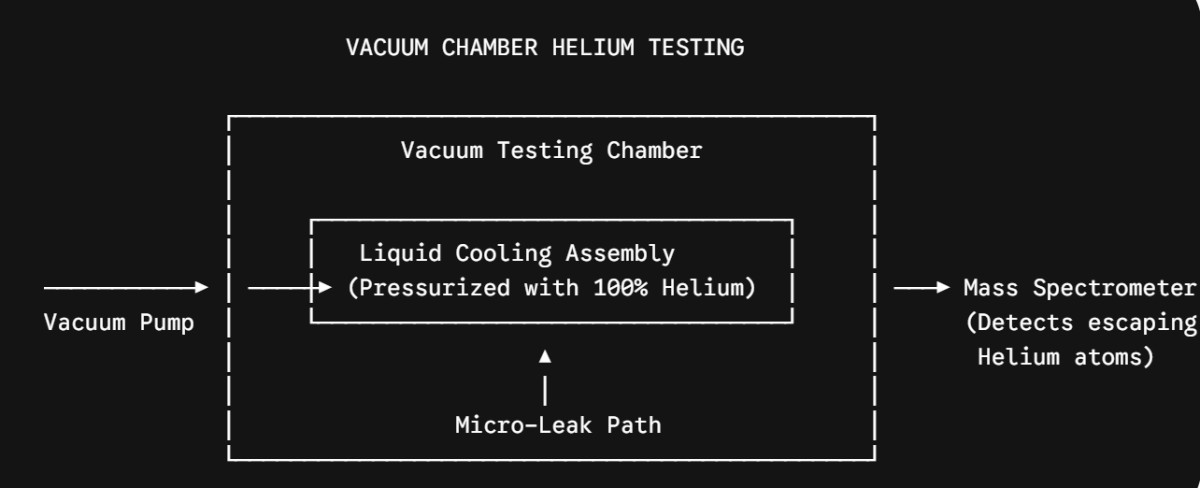
Internal Pressurization: The internal cavity of the stainless steel manifold or cooling loop is evacuated and backfilled with high-purity helium gas under controlled pressure.
Chamber Evacuation: The sealed component is placed inside an airtight vacuum chamber, which is pumped down to a high vacuum state.
Mass Spectrometer Analysis: A mass spectrometer connected to the vacuum chamber analyzes the evacuated atmosphere. If a micro-fissure exists, helium escapes into the vacuum chamber and is immediately quantified by the sensor.
By measuring leak rates as low as 1 × 10⁻⁹ mbar·L/s, this process ensures that the assembly will remain leak-free throughout its operational service life inside a data center rack.
4. Deep Dive 2: Optimized Manufacturing Workflows for Defect-Free Assemblies
Achieving a passing helium leak test result is not merely a final inspection step—it is the direct outcome of an optimized, end-to-end manufacturing process. Every step, from raw material selection to automated joining, plays a crucial role in eliminating weld porosity and thermal stress.
                               MANUFACTURING WORKFLOW
┌──────────────────┐    ┌──────────────────┐    ┌──────────────────┐    ┌──────────────────┐
│  Certified 316L  │───►│ Multi-Axis CNC │───►│ Closed-Loop     │───►│ Ultrasonic Wash  │
│  Raw Material    │                 │ Machining        │                │ Orbital TIG Weld │                   │ & Passivation    │
└──────────────────┘    └──────────────────┘    └──────────────────┘    └──────────────────┘
                                                                                 │
                                                                                 ▼
┌──────────────────┐    ┌──────────────────┐    ┌──────────────────┐    ┌──────────────────┐
│ Cleanroom    │◄───│ 100% Vacuum      │◄───│ Dimension &  │◄───│ Internal Surface │
│ Packaging     │               │ Helium Testing   │                 │ Pressure Check   │               │ Bore Inspection  │
└──────────────────┘    └──────────────────┘    └──────────────────┘    └──────────────────┘
Step 1: Material Verification and Precision Machining
Quality control begins with raw stock selection. Utilizing certified low-carbon 316L (UNS S31603) or 304L stainless steel prevents weld sensitization (chromium carbide precipitation at grain boundaries). Multi-axis CNC machining centers craft manifold blocks, port connections, and mounting flanges with tight tolerances, eliminating gap variances during assembly.
Step 2: Closed-Loop Orbital TIG Welding & Argon Purging
Manual welding often introduces heat inconsistencies, tungsten inclusions, and internal oxidation scale (commonly known as "sugaring").
Automated Orbital TIG Welding: Delivers precise, repeatable heat input across circular pipe joints, ensuring full-penetration welds without excessive heat-affected zones (HAZ).
High-Purity Argon Purging: Closed-loop internal purging maintains oxygen levels below 30 PPM during welding. This yields a silver-gold, smooth internal root bead free of oxide flakes that could otherwise break off and clog downstream 50-micron micro-channel cold plates.
Step 3: Chemical Passivation and Decontamination
Following welding, assemblies undergo multi-stage ultrasonic cleaning to remove residual oils and particulates. Components are then processed through ASTM A967-compliant citric or nitric acid passivation. This step strips free iron from the surface and artificially restores a thick, uniform chromium oxide passive film ((Cr₂O₃)), conferring superior corrosion resistance in deionized water and water-glycol environments.
Step 4: Integrated Vacuum Helium Testing & Cleanroom Packaging
Before final dispatch, every unit undergoes 100% vacuum chamber helium leak testing. Once validated, assemblies are double-bagged under cleanroom conditions to prevent ambient dust or moisture contamination during international transit.
5. Technical Comparison: Standard Fabrication vs. Optimized Precision Standards
To illustrate the value of integrated quality control, the table below highlights key differences between standard commercial metal fabrication and precision-engineered liquid cooling production:
6. Frequently Asked Questions (FAQ)
Q1: Why is helium chosen over nitrogen or air for high-reliability leak testing?
A: Helium molecules are significantly smaller than nitrogen and oxygen, allowing them to pass through microscopic micro-fissures and pinhole voids that air-based tests miss. Furthermore, helium is non-toxic, non-flammable, inert, and naturally present in air at only 5 PPM, making background signal noise extremely low during mass spectrometry testing.
Q2: What leak rate threshold is required for data center liquid cooling manifolds?
A: While standard industrial piping allows leak rates around 1 × 10⁻3 mbar·L/s x 1 × 10⁻5 mbar·L/s, mission-critical liquid cooling loops generally demand leak rates below 1 × 10⁻8 mbar·L/s or 1 × 10⁻⁹ mbar·L/s. This stringent threshold ensures that coolant remains entirely contained over multi-year operational cycles.
Q3: How does internal weld "sugaring" impact liquid cooling loops?
A: Sugaring refers to the rough, dark oxide scale that forms on the back side of an unpurged or poorly purged weld. Over time, high-velocity coolant dislodges these brittle oxide flakes. Floating particulates quickly travel to micro-channel cold plates, causing blockages, reduced thermal dissipation, localized server overheating, and pump impeller erosion.
Q4: Can custom manifold prototypes be tested using helium mass spectrometry without expensive tooling setup?
A: Yes. Modern helium vacuum chambers accommodate custom mounting fixtures and variable component geometries. This allows small-batch prototypes and custom-designed server manifolds to undergo the exact same rigorous leak validation as high-volume OEM production lines.
7. Partner with Engineering Precision for Zero-Defect Liquid Cooling
             READY TO ELEVATE YOUR LIQUID COOLING RELIABILITY?

  ┌─────────────────────────────────────────────────────────────────────┐
  │  ✓ 100% Vacuum Chamber Helium Leak Testing (<1×10⁻⁹ mbar·L/s)       │
  │  ✓ Certified 316L/304L Low-Carbon Stainless Steel Construction       │
  │  ✓ Closed-Loop Orbital TIG Welding with <30 PPM Argon Purge         │
  │  ✓ Full ASTM A967 Chemical Passivation & Cleanroom Packaging        │
  │  ✓ Rapid Turnaround: 7–20 Day Component Production Cycles           │
  └─────────────────────────────────────────────────────────────────────┘
Protect your high-density computing infrastructure from fluid leaks, contamination, and thermal downtime. Build your next generation of liquid cooling distribution manifolds, custom piping, and quick-disconnect sub-assemblies with a manufacturing partner committed to uncompromising quality standards.
Contact our engineering team today to review your technical drawings, request a quotation, or discuss custom manufacturing workflows for your liquid cooling projects.
What Can We Do For You